


My list grew 34% in 54 days. My open rate fell from 21% to 13%. And the number of people who actually open each issue barely moved: about 40.
On August 12, 2026, I stopped all subscribe-for-subscribe. No reciprocity threads, no “sub back”, no engagement pods.
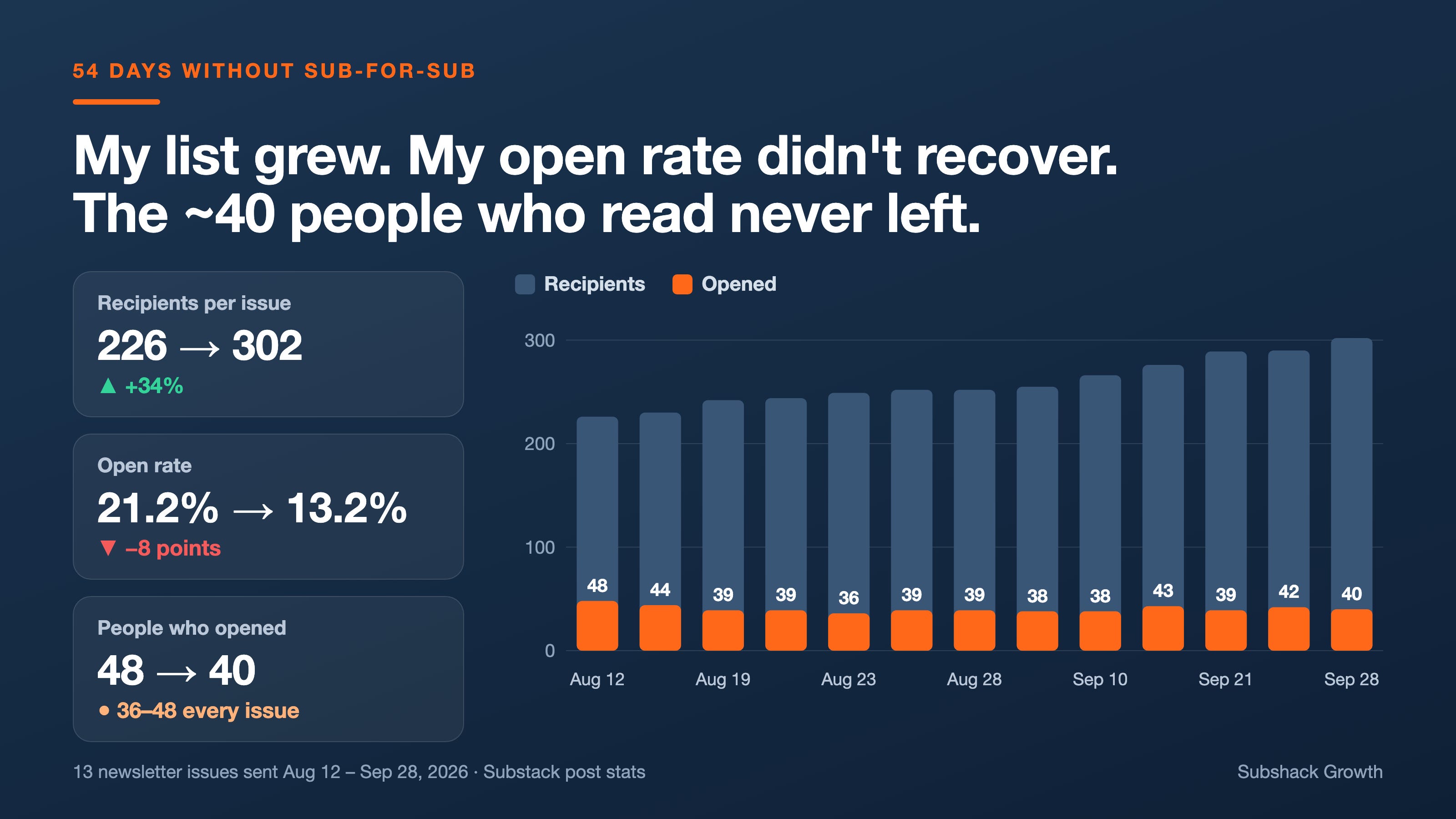
That chart is the whole story, so let me say it plainly: quitting sub-2-sub did not restore my open rate. The damage was already done. When my list was 53 people, 34% of them opened. Reciprocity grew the list and diluted it.
Half the people on my list didn’t want to read my work. They wanted a subscriber back. Most of them are still on the list today. They just don’t open. That is what a ghost audience looks like in the data.
Here is what happened over 54 days: the drop, the system I used instead, and where the numbers stand today.
Phase 1: The initial shock (days 1-14)
When you quit sub-2-sub cold turkey, the dashboard hits you first.
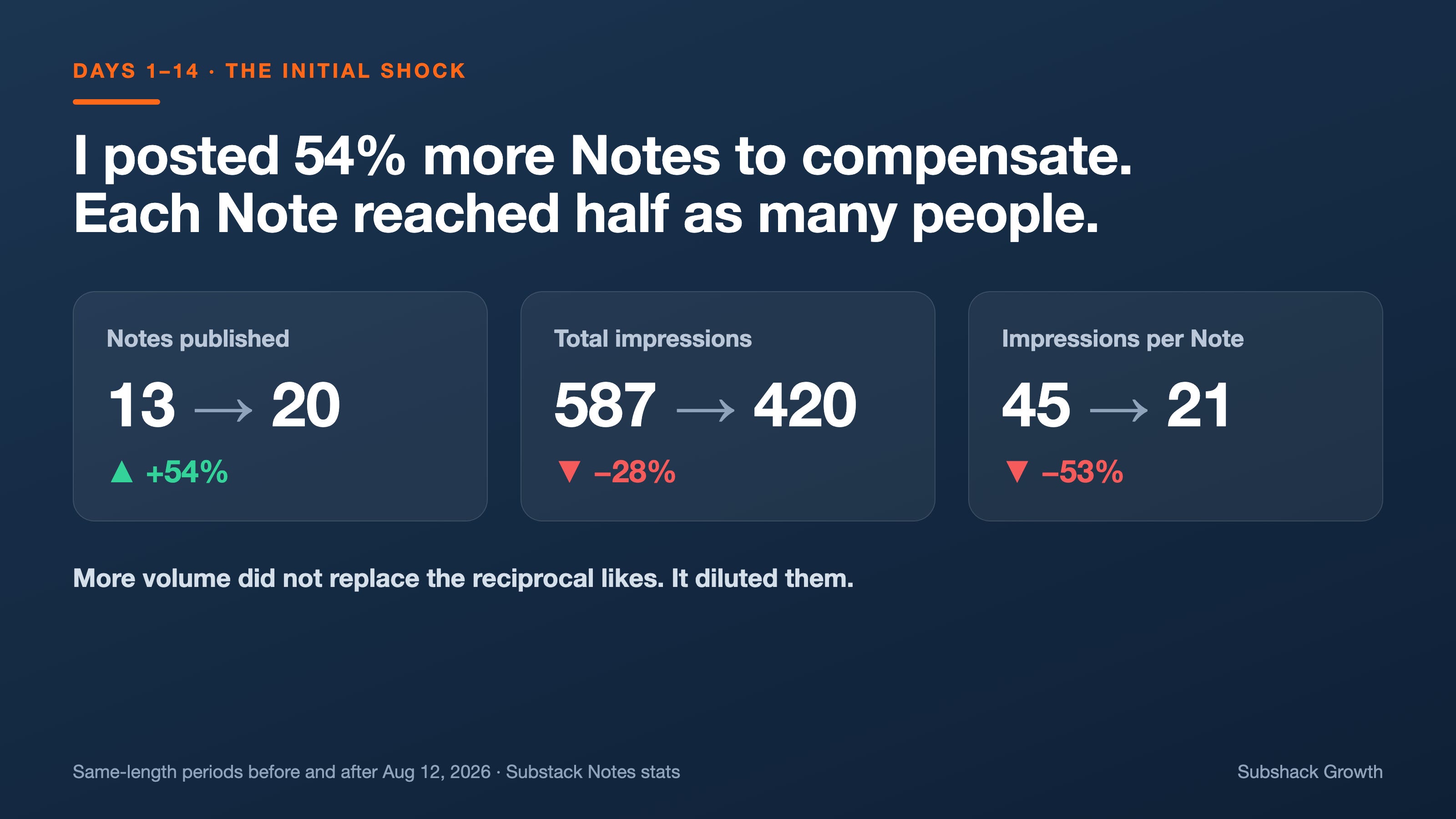
Reach per Note collapsed. I published 54% more Notes to compensate (13 → 20). Total impressions still fell 28% (587 → 420). Per Note, reach fell by more than half: 45 → 21 impressions. What disappeared were reciprocal likes, not readers.
The vanity metrics froze. The automatic likes disappeared. The subscriber counter stopped ticking on its own.
This is the moment most creators panic and go back to engagement pods and reciprocity threads.
Phase 2: The 4-part organic system (days 15-54)
To build an audience of real readers without transactional hacks, I committed to four habits.
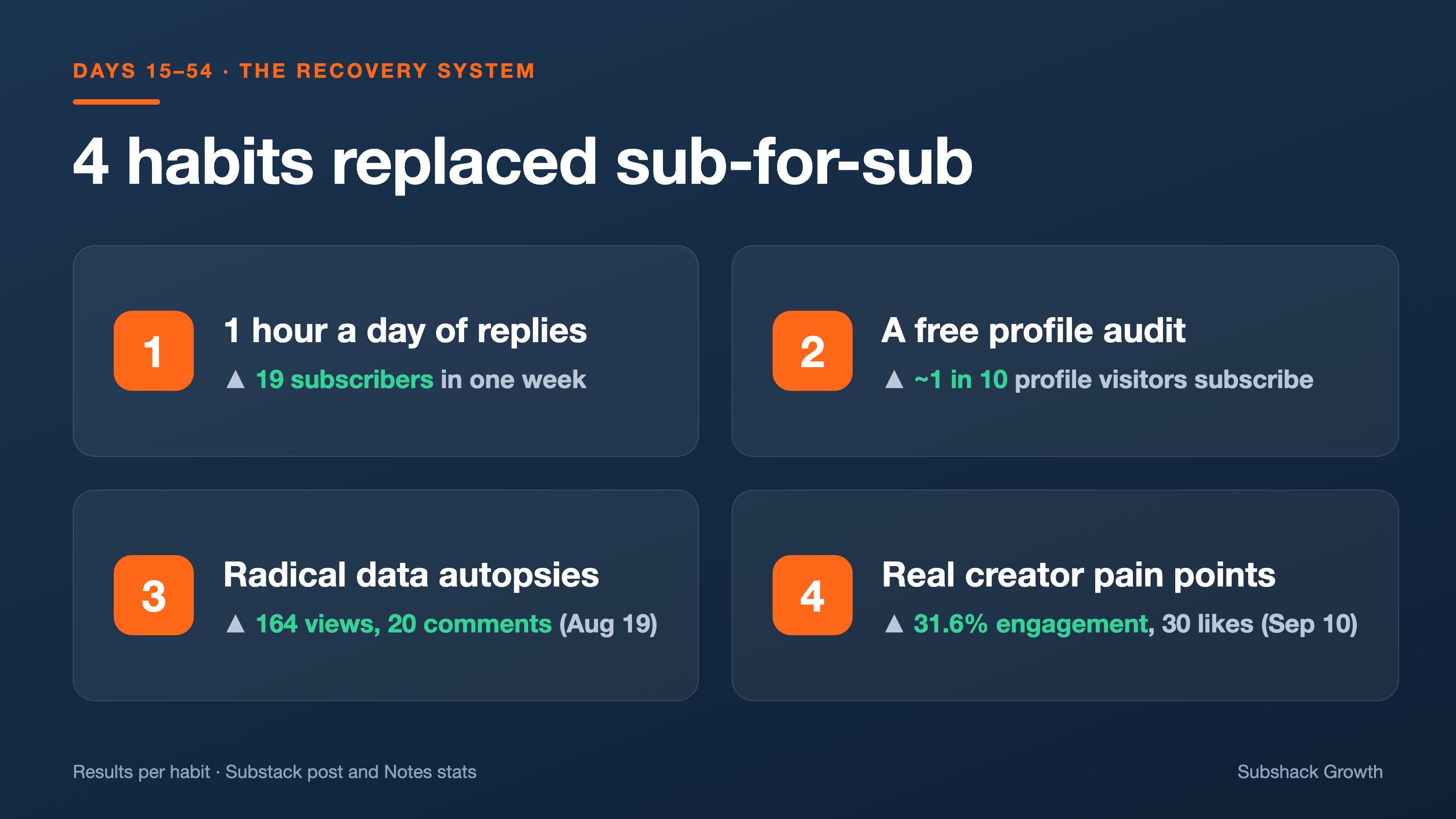
1. One hour a day of targeted replies
Instead of broadcasting generic Notes into the void, I spent one hour a day writing thoughtful replies under Notes from creators my readers already follow.
Result: 19 subscribers came through Notes in a single week, with no viral Note.
2. A free diagnostic instead of “please subscribe”
I built a free Substack profile audit. Instead of asking people to subscribe, it scores their profile clarity out of 100 in about 10 seconds.
Result: a clear profile converts about 1 in 10 profile visitors into subscribers.
3. Radical data autopsies
On August 19, I published a raw dissection of my own mistakes: I Checked the Data Behind My Own Growth Advice. It Was Worse Than I Thought.
Result: 164 views and 20 comments, my best-read issue since quitting sub-2-sub. Dissecting real failures builds more trust than broadcasting fake success.
4. Real creator pain points
On September 10, I wrote about a friction point every creator was feeling: Substack’s AI Detector Is Creating a Problem Nobody Expected.
Result: a 31.6% engagement rate, my highest of the period, plus 30 likes and 2 new subscribers.
Phase 3: Where the numbers stand at day 54
64 readers were active in the last 30 days.
That is 30.6% of the reachable list, and the real size of this publication. Not the subscriber count.
Behind them: 312 subscribers, all free, and 437 followers.
Recipients per issue 226 → 302 (+34%)
Open rate 21.2% → 13.2%. It did not recover.
People opening each issue between 36 and 48, every single issue
Best click-through rate 23.7% (Sep 1) and 18.6% (Sep 14), against 0-6% for the issues sent Aug 2-10
Peak engagement 31.6% on a creator pain-point post
Subscriber intent from “sub back” to search, recommendations and profile audits
The open rate is the uncomfortable number. It keeps falling because the reciprocal subscribers from my first weeks are still on the list, and they don’t open. The number that matters stayed flat: the same ~40 people read every issue while the list around them grew. My next step is cleaning the list so the open rate shows real readers again.
Key takeaways for Substack writers
Transactional growth builds a directory, not a publication.
Quality beats volume. 100 subscribers at 34% or 200 subscribers at 18%? Both give you about 35 readers. The second list costs twice the effort to reach the same people.
Roots grow in the dark. If your counter feels slow because you chose quality over hacks, keep going. Count the people who open, not the people who subscribed.
Find the 3 things costing your Substack subscribers
The free profile audit scores your Substack profile out of 100 and shows what a first-time visitor sees in 10 seconds.
Thanks for sharing it with us! Your posts are always empirically grounded. And yes, as I started one of my essays: “Every writer on Substack dreams of finding genuine readers. Still, so many of us spend our first months talking almost exclusively to other writers, navigating a strange ecosystem of engagement notes and algorithmic acrobatics.”
It’s not easy to find the best strategy. And sometimes the best strategy is not the most obvious one.