


The Truth About My Substack Growth — Part 2 of 5
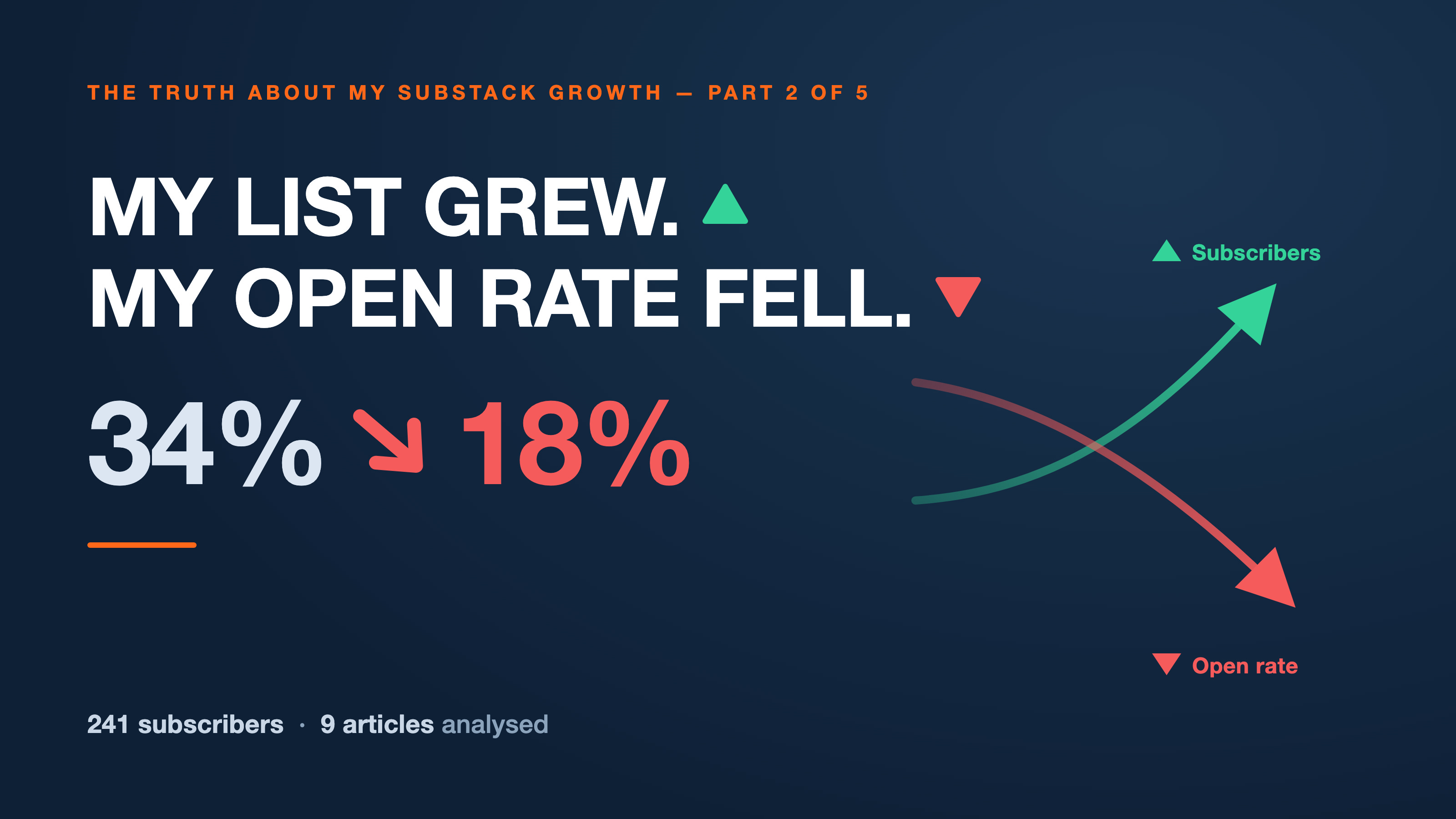
Subscriber count told me I was growing.
Open rate told me to slow down.
Neither number told the whole truth.
I went from zero to more than 150 subscribers during my first week on Substack.
By the time of this audit, the publication had reached 241 subscribers.
From the outside, the direction was obvious:
More subscribers meant more growth.
But after auditing the Notes responsible for that growth, I looked at what happened after people subscribed.
The result was less flattering.
On August 3, one of my articles recorded a 34% open rate.
Ten days later, my newest article recorded 18%.
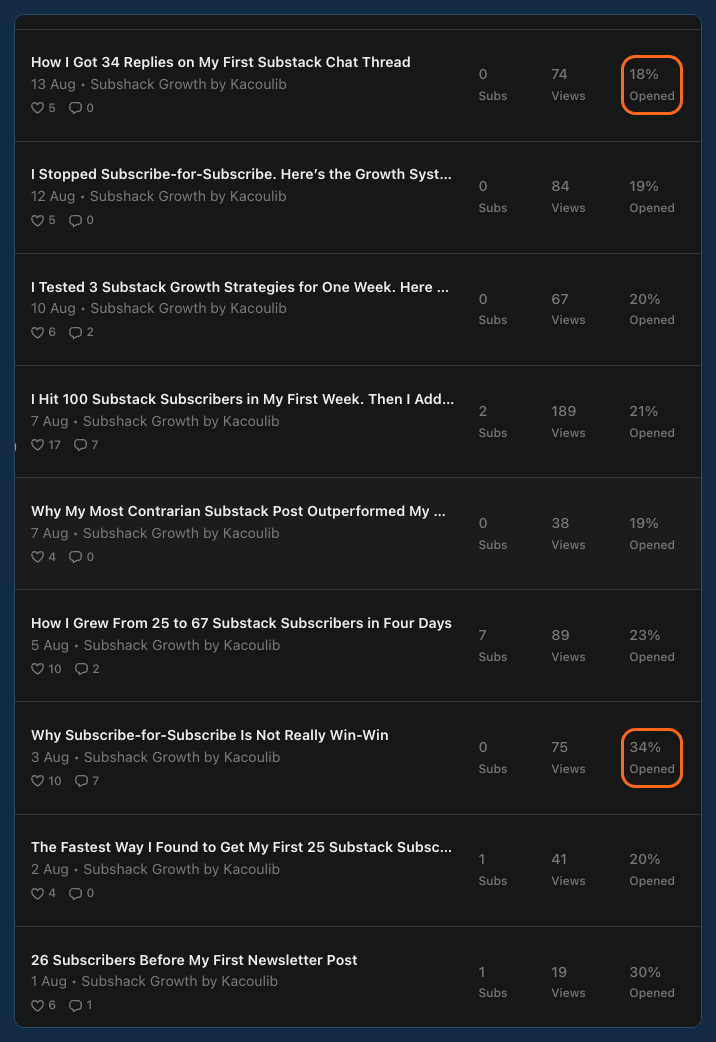
That is a decline of 16 percentage points—or roughly 47% relative to the earlier rate.
My list was getting bigger.
The percentage of it opening my new articles was getting smaller.
The pattern across my first nine articles
The decline did not happen in a perfectly straight line.
These were the recorded open rates:
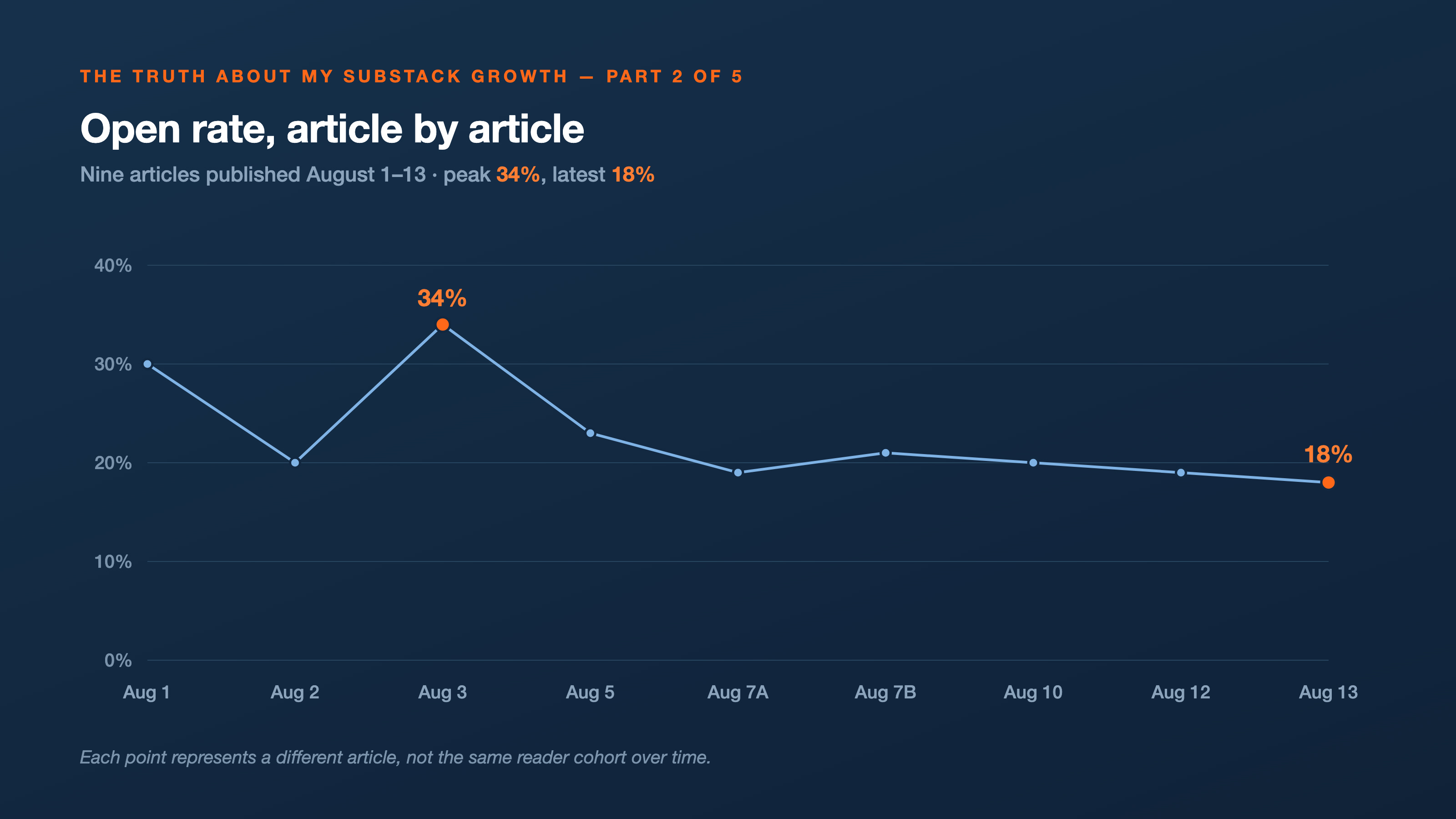
The 34% result was the high point, not the permanent baseline.
But the later pattern is still difficult to ignore.
Every article published after August 5 recorded an open rate between 18% and 21%.
Meanwhile, the subscriber count continued rising.
The list was expanding faster than reader attention.
A falling open rate does not automatically mean fewer readers
This distinction matters.
A percentage can fall while the absolute number of readers still rises.
For example:
100 subscribers at a 34% open rate means 34 opens.
200 subscribers at an 18% open rate means 36 opens.
The second list has a much weaker rate but slightly more total readers.
So I cannot honestly say that my audience disappeared simply because the percentage declined.
A larger list can still create more reach.
The problem is efficiency.
I needed almost twice as many subscribers to produce roughly the same number of opens.
That means subscriber growth and audience growth are not always the same thing.
One measures how many people joined.
The other measures how many people continue paying attention.
The explanation I cannot prove—but cannot ignore
The most obvious explanation is acquisition quality.
In Part 1, I found that the two strongest networking Notes accounted for 56 of the 62 subscribers Substack attributed to individual Notes.
One explicitly offered reciprocal support.
The other told writers I was reading, subscribing and supporting them.
Both generated subscribers quickly.
But someone who subscribes because they expect support in return is not necessarily subscribing because they want my next article.
When the next email arrives, the original reason for subscribing matters.
Did they join because they wanted:
Substack growth experiments?
data and practical tactics?
updates about building Subshack?
or simply another subscriber in return?
Those motivations all produce the same +1 in the subscriber count.
They do not produce the same reading behaviour afterward.
The falling open rate is consistent with audience dilution.
But it does not prove that reciprocal growth caused it.
What the data cannot tell me
This audit covers only nine articles from a publication that was a few weeks old.
The articles also had different:
titles
subjects
publication dates
levels of relevance
amounts of promotion
The 34% article discussed why subscribe-for-subscribe was not really win-win.
The 18% article documented my first Substack Chat experiment.
The difference in subject alone may explain part of the gap.
I also do not have a clean cohort analysis showing:
which acquisition source produced each reader
whether reciprocal subscribers opened less often
whether organically acquired subscribers returned more frequently
how engagement changed for the same subscribers over time
So the accurate conclusion is not:
Reciprocal subscribers caused my open rate to fall.
It is:
My subscriber count increased while the open rates on later articles remained materially below my early high points. Reciprocal acquisition is one plausible explanation, but the available data cannot isolate the cause.
That sentence is less dramatic.
It is also more honest.
The subscriber count hides different types of growth
Before this audit, I treated every new subscriber as an identical unit of growth.
Now I see at least three different possibilities.
Transactional growth
Someone subscribes because I subscribed, replied or offered support first.
Community growth
Someone subscribes because we interacted, share the same experience or belong to the same creator network.
Editorial growth
Someone subscribes because the content itself created enough interest for them to want the next piece.
All three subscribers are real people.
All three may eventually become genuine readers.
But their original motivation is different.
A dashboard that combines them into one number cannot explain why the list grows while the open rate weakens.
What I should have measured from the beginning
Subscriber count is still useful.
It just needs context.
I should have tracked it alongside:
article open rate
total views
comments and replies
restacks
returning readers
unsubscribes after each publication
the mechanism that produced each subscriber
The most important question is no longer:
How many subscribers did this tactic produce?
It is:
What did those subscribers do after joining?
Did they open the next article?
Did they read a second one?
Did they reply without expecting anything in return?
Did they share the work with their own audience?
That behaviour is much closer to audience growth than the initial subscription.
What I am changing now
I am not deleting reciprocal subscribers or pretending the early growth never happened.
The raw numbers remain part of the story.
But I am changing what I allow those numbers to teach me.
A networking Note can be excellent for meeting creators.
It should not automatically become evidence that the subject of the Note created editorial demand.
A reciprocal subscription can begin a real relationship.
It should not automatically carry the same weight as someone who subscribed after reading an article.
And a growing list should not be celebrated without checking whether people continue opening the work.
For the next articles, I am watching both sides:
acquisition: who subscribes and why
retention: who returns and continues reading
Growth needs both.
The uncomfortable conclusion
My publication reached 241 subscribers quickly.
That achievement is real.
But the open-rate pattern suggests that the list may have grown faster than the audience’s interest in my work.
I did not necessarily build a smaller audience.
I may have built a larger audience with weaker average intent.
That is not the same failure.
But it requires a different strategy.
The goal is no longer to make the subscriber count rise as quickly as possible.
The goal is to make the next subscriber more likely to become a reader.
That starts before the subscription, on the profile they land on. I built a free Substack profile audit that scores what a first-time visitor sees, out of 100.
If your subscriber count doubled while your open rate nearly halved, would you still call it growth?
Would you prefer a smaller, highly engaged list—or a larger list that produces more total reach but weaker average engagement?
Tell me which one you would choose in the comments.
Next in Part 3: How I taught Subshack to distinguish organic, community-driven and reciprocal growth—after the first version classified my own article as reciprocal content.
I think you covered the whole story very accurately, and hats off that you didn’t come to hasty conclusions. I can add a personal example: I work for a media company operating thematic broadcast television channels across Central and Eastern Europe. In that region television subscribers cannot make their subscription package on an a la carte basis but they can only subscribe to pre-set packages, where the channel line-up is grouped by genre in most cases, e.g. kids’ channels are in a block, followed by news channels, etc. In some cases these operators run a so-called promotional channel with favorable EPG position where they rotate the thematic channels monthly (it’s mainly for upselling purposes). What happens when a channel appears there? Reach grows, while average time spent declines. If the reach grows proportionally more, then the conversion was beneficial. I think neither way is ultimately good or bad, but if I needed to make a choice, I’d choose the higher reach and lower time spent combination. Not because it’s better, but it’s more stable: performance doesn’t depend on a limited number of viewers (in your case: readers).
The reach growth or the favorable conversion rate however doesn’t always happen. I’m a big believer that it has much more to do with the content itself rather than with the system/method. If the content is niche, or the competition is substantial, it doesn’t necessarily translate to higher interest. In your case: you write mostly about growth tactics and related experiences on Substack. It’s an interesting topic, but the competition is fierce - there are a lot of publications dedicated to this very topic, some of them seem really successful. Why them? Who knows. Sometimes I feel the authors of these successful publications don’t understand it clearly either.