


I wasn’t planning to write an article about AI detection.
Then I started posting about Substack’s new AI detector.
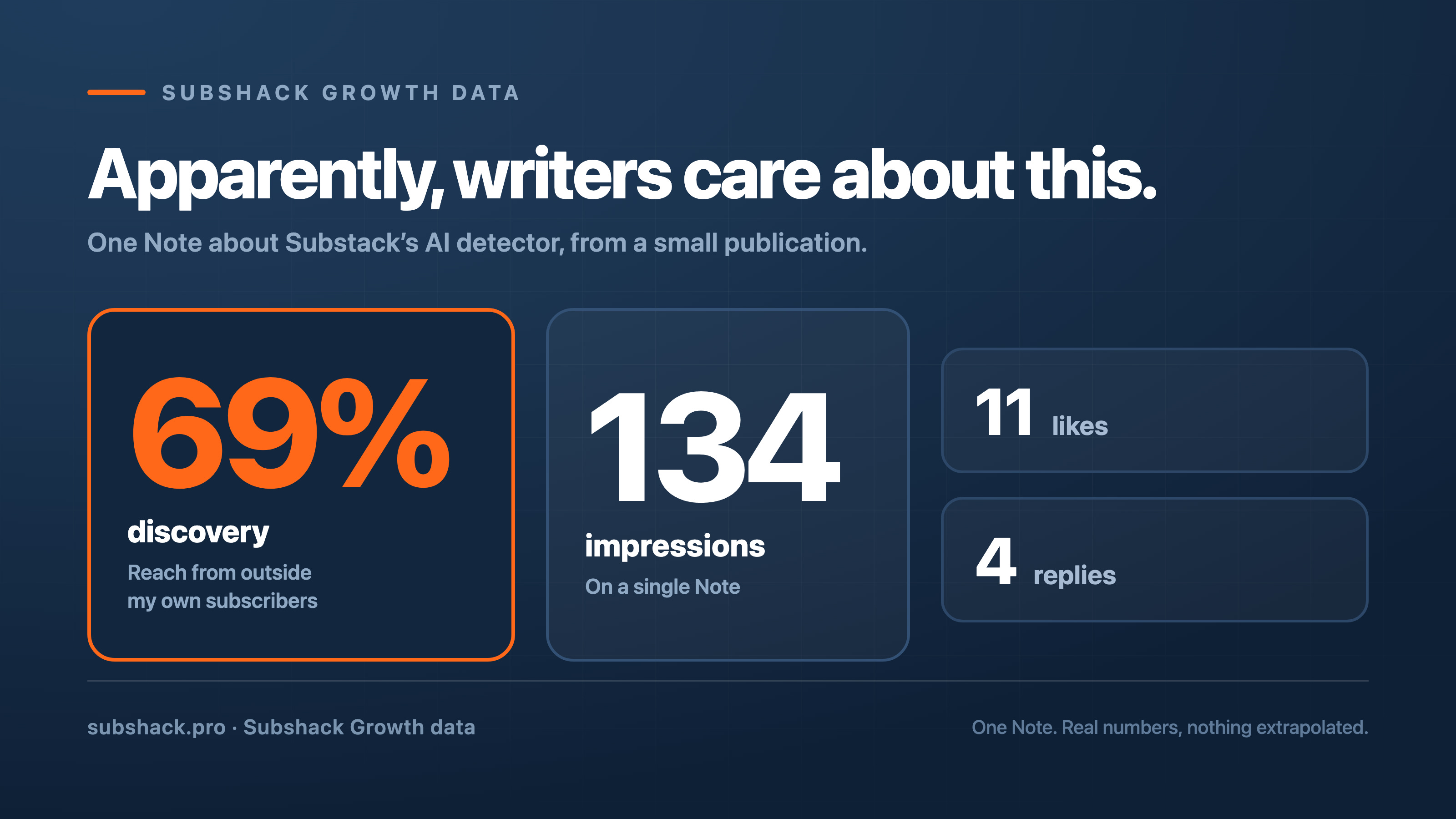
One of those Notes reached 134 impressions, 11 likes and 4 replies, with 69% discovery.
Another reached only 48 impressions but generated a new subscriber.
For my small publication, that was enough to tell me something.
Writers have opinions about this.
And I think the most interesting problem with AI detection isn’t actually AI.
It’s what happens to human writers once they know they’re being scored.
What Substack actually launched
In July, Substack introduced Scan for AI text, powered by Pangram.
Readers can scan eligible Posts, Notes, comments and replies and receive an estimate of how much of the text appears human-written or AI-assisted.
Creators can also scan their own drafts, report a detection error and disable detection on individual pieces of content.
Substack’s reason for doing this makes sense.
Trust matters.
If a reader thinks they’re paying to read someone’s ideas and instead gets hundreds of automatically generated articles, that changes the relationship.
Chris Best even acknowledged something important when Substack announced the feature:
The detector cannot tell whether great human care went into a piece. It also cannot tell whether AI was simply used as a source or research tool. And Substack explicitly says the detector is not perfect.
So far, fair enough.
But the feature introduces another question writers didn’t have to ask before.
“Is this good?” becomes “Does this look human?”
Imagine spending four hours writing something.
You research it.
Rewrite the introduction.
Delete paragraphs.
Change your mind halfway through.
Finally, you’re happy with it.
Then you run the detector.
82% AI.
What happens next?
You know you wrote it.
But your readers don’t.
Do you publish it anyway?
Do you add a statement defending yourself?
Do you disable detection?
Or do you start changing sentences until a machine agrees that you sound human?
That last option is the one I find fascinating.
Because suddenly the detector isn’t just observing writing.
It’s influencing writing.
This is already becoming a real dilemma
Today, I found a writer describing almost exactly this situation.
They said they wrote their first Substack feature entirely themselves, using Grammarly only for proofreading.
Substack’s detector reportedly classified the text as 100% AI-generated.
They then tested the same text with several other AI detectors, which reportedly classified it as human-written.
That is one person’s report.
It does not prove that Pangram has a widespread false-positive problem.
But the reaction is more interesting than the score itself.
The writer essentially asked:
Should I change writing I know I wrote because an AI detector thinks AI wrote it?
That is a completely new writing problem.
Even a highly accurate detector can change behavior
This is why I think the false-positive debate is only part of the story.
Imagine the detector becomes extremely accurate.
The behavioral problem still exists.
Once a score exists, people optimize around the score.
We already do this everywhere online.
We change headlines for click-through rates.
We change articles for Google.
We change thumbnails for YouTube.
We change posts for algorithms.
Now writers have another metric available to optimize:
How human does my writing look?
And that creates a bizarre feedback loop.
Write something.
Scan it.
Get an AI score.
Change your writing.
Scan it again.
Repeat until the machine thinks you sound sufficiently human.
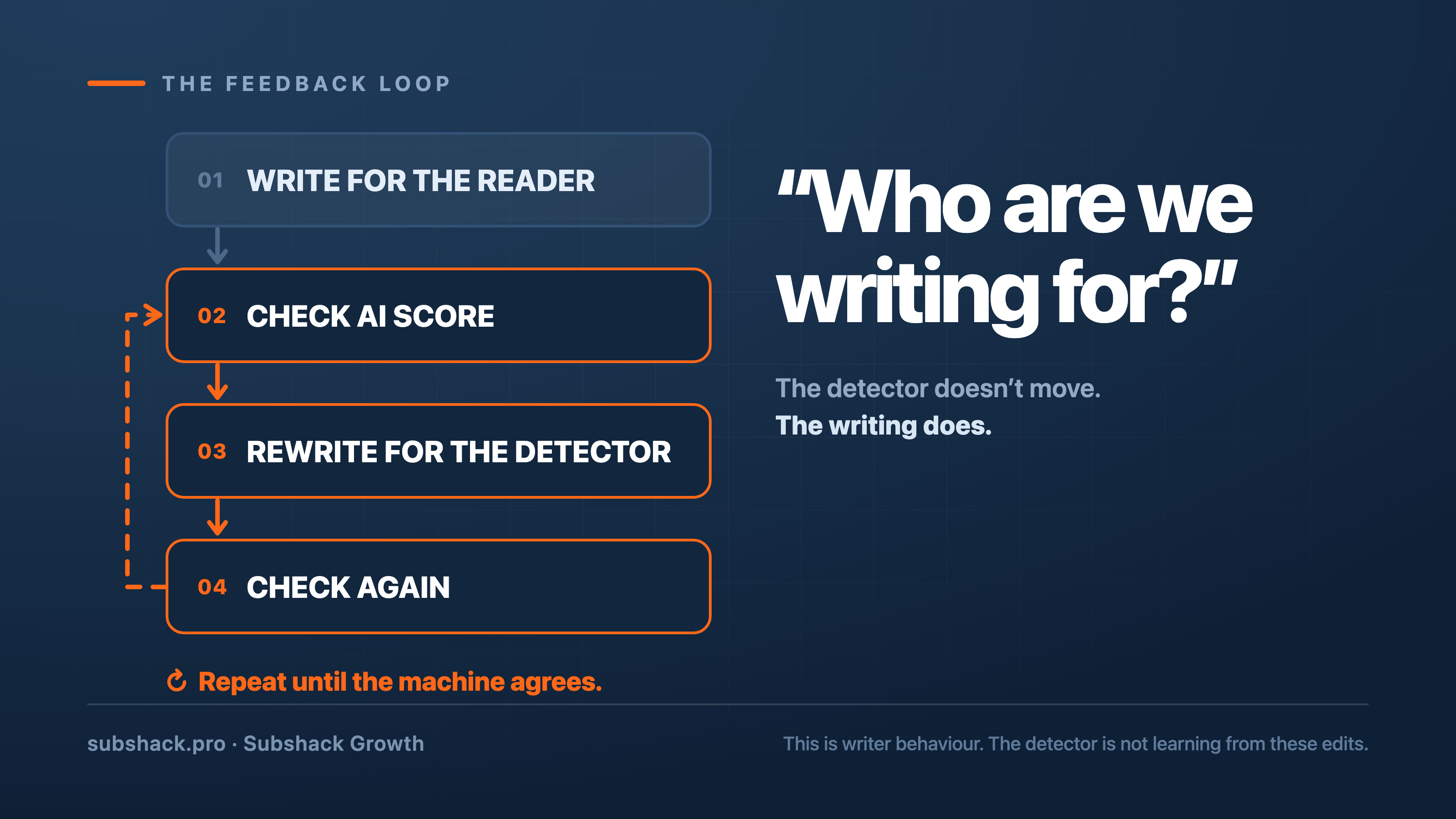
At that point, who exactly are you writing for?
“100% human-written” could become a status symbol
I posted another thought about this recently.
I think we might eventually see writers putting things like:
100% human-written
in their bios, About pages or marketing.
Not because the writing is necessarily better.
But because authorship itself becomes part of the product.
For some publications, that could genuinely matter.
Readers may want essays, personal stories or journalism created directly by a person.
Other readers may not care whether AI helped with editing, research or structure.
That’s fine too.
The problem starts when a percentage becomes a shortcut for quality.
Because these are very different questions:
Was AI involved?
and
Is this worth reading?
A perfectly human article can be terrible.
An author can also use AI somewhere in their process while contributing original research, experience, judgment and ideas.
The percentage alone cannot answer that.
I think writers should optimize for trust, not the detector
I’m not going to tell writers to ignore AI transparency.
Quite the opposite.
If you use AI heavily, tell people.
If you don’t, say that too if it matters to your audience.
Substack even created a “How I make this” statement specifically so creators can explain their process.
But I wouldn’t rewrite a sentence I believe is good simply because a detector dislikes it.
And I definitely wouldn’t start deliberately making my writing worse, stranger or less polished to increase a “human” percentage.
Because then we arrive at the strangest possible outcome:
Humans changing how they write so that an AI believes they are human.
That seems like the exact opposite of what these tools are supposed to achieve.
The question I want to optimize for is still much simpler:
Was this worth reading?
Everything else comes second.
I’m curious how other writers are handling this.
Have you scanned your own writing yet?
And if Substack told you something you wrote yourself was mostly AI-generated, would you change it?
I’m documenting my Substack growth experiments and the data behind them while building Subshack.
Next experiment: I currently have 277 subscribers, but only 61 opened an email in the last 30 days. I want to understand what a “subscriber count” actually tells us.