


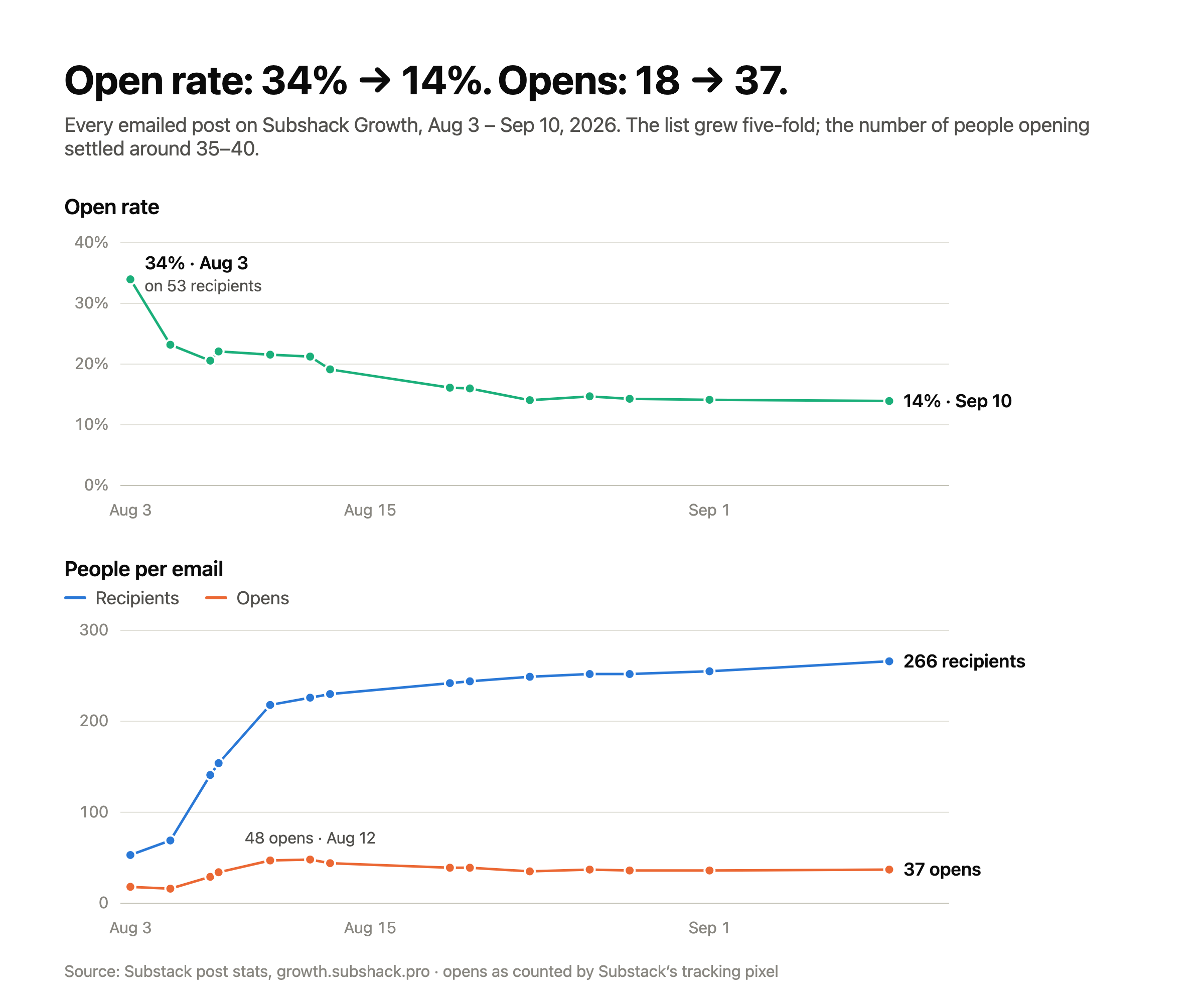
On August 3rd, my Substack open rate was 34% (Why Subscribe-for-Subscribe Is Not Really Win-Win), on just 53 recipients.
By August 12th, it had dropped to 21%.
By August 20th, it hit 16%.
And on my last two issues in September, it bottomed out at 14%.
During that exact same period, the number of people receiving each email grew from 53 to 266. On paper, the publication looked like it was expanding. In reality, every new issue was reaching a smaller fraction of the inbox than the one before it.
If you publish on Substack, you have probably felt this specific tension: celebrating a milestone subscriber number while watching your open rate quietly bleed out.
Here is the raw data from my emailed posts, why open rates lie (in both directions), what my own subscriber export showed, and the exact protocol I ran on September 15 to clean my list without deleting real readers.
1. The Raw Data: A 20-Point Open Rate Slide
Here is the exact progression across a selection of my emailed posts:
3 Aug: 34% open rate (Why Subscribe-for-Subscribe Is Not Really Win-Win) : 18 opens out of 53 recipients · 77 views
5 Aug: 23% open rate (How I Grew From 25 to 67 Substack Subscribers...) : 16 opens out of 69 recipients · 91 views
7 Aug: 22% open rate (I Hit 100 Substack Subscribers in My First Week...) : 34 opens out of 154 recipients · 223 views
12 Aug: 21% open rate (I Stopped Subscribe-for-Subscribe...) : 48 opens out of 226 recipients · 89 views
20 Aug: 16% open rate (My Subscriber Count Grew. My Open Rate Fell From 34% to 18%) : 39 opens out of 244 recipients · 85 views
1 Sept: 14% open rate (I Checked My Last 40 Substack Subscriptions...) : 36 opens out of 255 recipients · 87 views
10 Sept: 14% open rate (Substack’s AI Detector Is Creating a Problem...) : 37 opens out of 266 recipients · 80 views
The pattern looks undeniable. It is not the whole story.
Look at the opens, not the percentage: 18 people opened on August 3. 48 opened on August 12. 37 opened on September 10. The number of people actually opening did not collapse. It grew, then settled around 35 to 40, while the list kept growing underneath it.
Most of that growth came through Notes while I was doing subscribe-for-subscribe: 162 of the 215 people who joined between August 1 and August 12 subscribed from a Note. People who clicked Subscribe, not people who read. The percentage fell because the denominator grew.
2. Why “0% Open Rate” Does Not Mean “Dead Reader”
When faced with a 14% open rate, the instinct is to export your CSV, filter by Activity = 0, and hit delete.
That is a mistake. Here is why:
Email pixels lie in both directions: Apple Mail Privacy Protection (MPP) pre-loads the tracking pixel, so it can count an open that never happened. Email clients that block images or show text only do the opposite: a reader can read every word without triggering a single open event.
The Substack App Factor: Readers who read your posts exclusively inside the Substack iOS/Android app or on the web do not always register as email openers.
Channel vs Exact Attribution: Just as 19 subscribers came through Notes without being attributed to a single Note, engagement often happens on profile surfaces rather than in the inbox.
Deleting people purely because an open-tracking pixel returned zero will silently wipe out some of your most attentive app-based readers.
When I exported my own list on September 15, the data proved it:
275 subscribers in total. 215 of them joined between August 1 and August 12, while I was still doing subscribe-for-subscribe.
154 of those 215 had never opened a single email.
But 62 of those 154 still showed activity: 54 had viewed my posts on the web or in the app. A “0 opens” filter would have deleted them.
71 had never received an email at all (email turned off, app-only readers). “0 opens” says nothing about them.
23 had clicked a link inside my emails while Substack counted zero opens. Their pixel was blocked. They are readers.
A delete-by-0-opens cleanup would have removed at least 67 people who were demonstrably reading.
3. The List Cleaning Protocol I Actually Ran
Here is exactly what I did on September 15, and what happens next.
Step 1: Isolate the Silent Cohort
I kept only free subscribers who met every one of these conditions:
Joined between August 1 and August 12, the subscribe-for-subscribe window. My publication is only six weeks old, so a “joined more than 60 days ago” rule would have matched nobody.
Received at least one email (among subscribers with no other activity, this removed 36 app-only readers).
Zero recorded email opens.
Zero post views on the web or in the app.
No activity and zero link clicks (this removed 5 more people who had clicked a link).
That left 51 subscribers out of 275. I did not filter on Notes activity: the export does not include likes, restacks or comments on Notes, so I check those names by hand before removing anyone.
Step 2: Send a “Stay or Leave” Re-engagement Post
Before removing anyone, I sent a short email to those 51 people only (a saved Substack segment) on September 15:
> Subject: Should I remove you from the Subshack Growth list?
> On August 12, I stopped doing subscribe-for-subscribe to focus only on high-value content.
> If you want to keep receiving my case studies and raw analyses, click the button below:
> [ Keep my free subscription → ]
> If you do nothing, your address will be removed in 7 days.
A P.S. also pointed to two free tools: the Subscribe-Back Checker and the profile audit.
Nothing happens automatically: Substack does not remove anyone for you. On September 22, I will export the list again and keep anyone who clicked, opened or read a post in the meantime. Then I check the remaining names against my Notes activity and remove the rest by hand. I will publish the results in a follow-up post after September 22: who stayed, who left, and whether this actually helped my open rate. Subscribe so you don’t miss it.
Two traps I hit while setting this up: a saved Substack segment built with an “email is any of” filter silently lost that filter and grew to my entire free list (273 people). Rebuild the cohort with activity filters, and re-open the segment before you send. And a post sent to a segment is still public in your archive.
4. Fix Your Landing Page First
Cleaning your list fixes your retention. But if your public Substack profile is leaky, new visitors will continue to bounce.
Whether or not you prune your list, run your profile through the free audit tool:
👉 Score My Substack Profile /100 →
It checks your positioning (35 pts), conversion hooks (25 pts), brand trust (15 pts), activity (15 pts), and SEO (10 pts) in 10 seconds without requiring a login.
What is your current Substack open rate? Have you ever purged inactive subscribers? Hit reply or drop a comment below. I read and answer every response.