


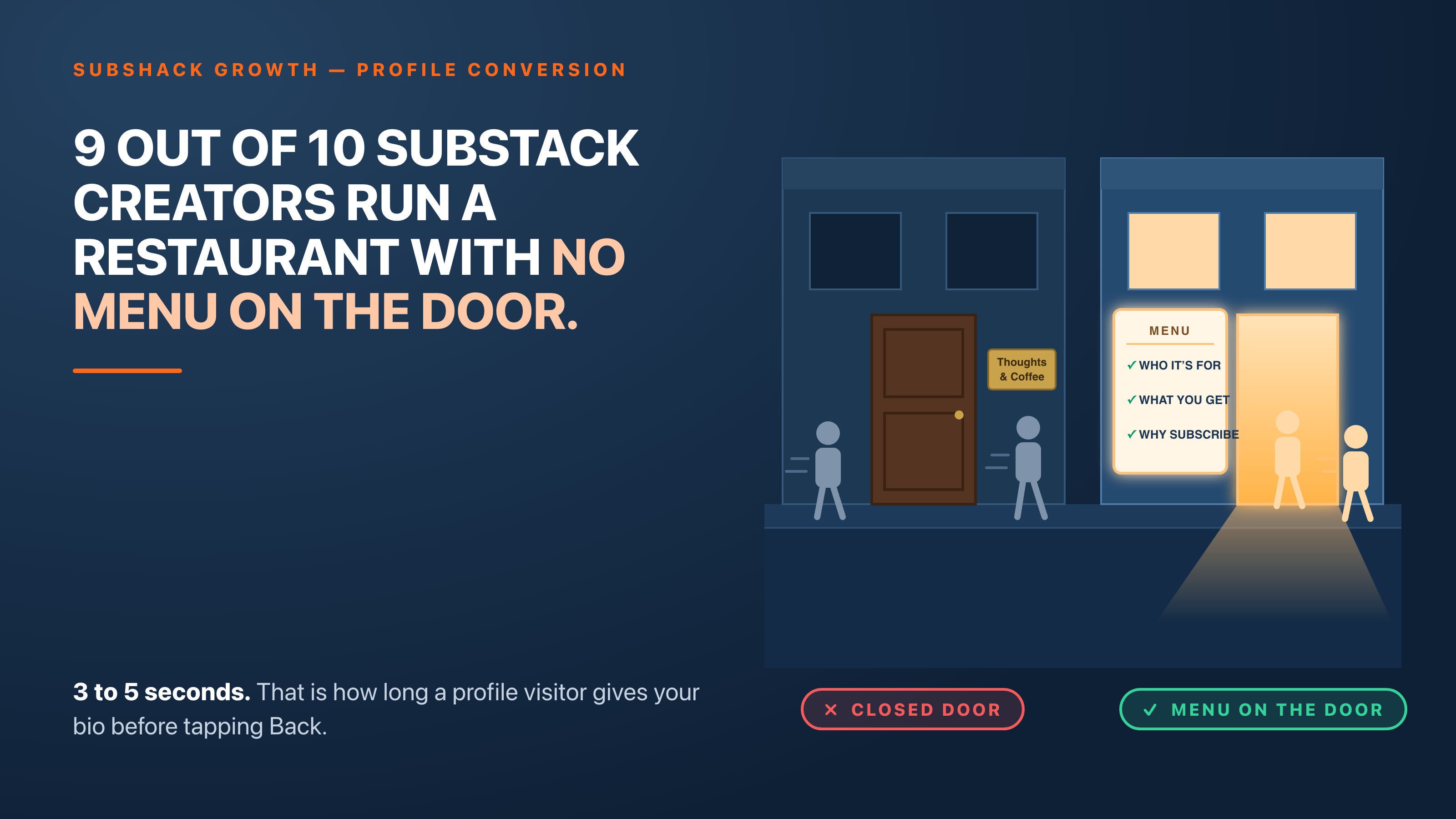
Imagine walking down a busy street looking for dinner. You stop in front of two restaurants:
Restaurant A has a clear menu posted on the door: exact dishes, prices, ingredients, and dining options. In 3 seconds, you know whether it fits your taste and budget.
Restaurant B has a closed wooden door with a tiny brass plaque that reads: “Exploring the quiet culinary spaces between taste and memory.”
Which restaurant do you walk into?
On Substack, 9 out of 10 creators are running Restaurant B. They spend dozens of hours writing articles and Notes, only to send interested profile visitors to a bio that refuses to state what the publication is actually about.
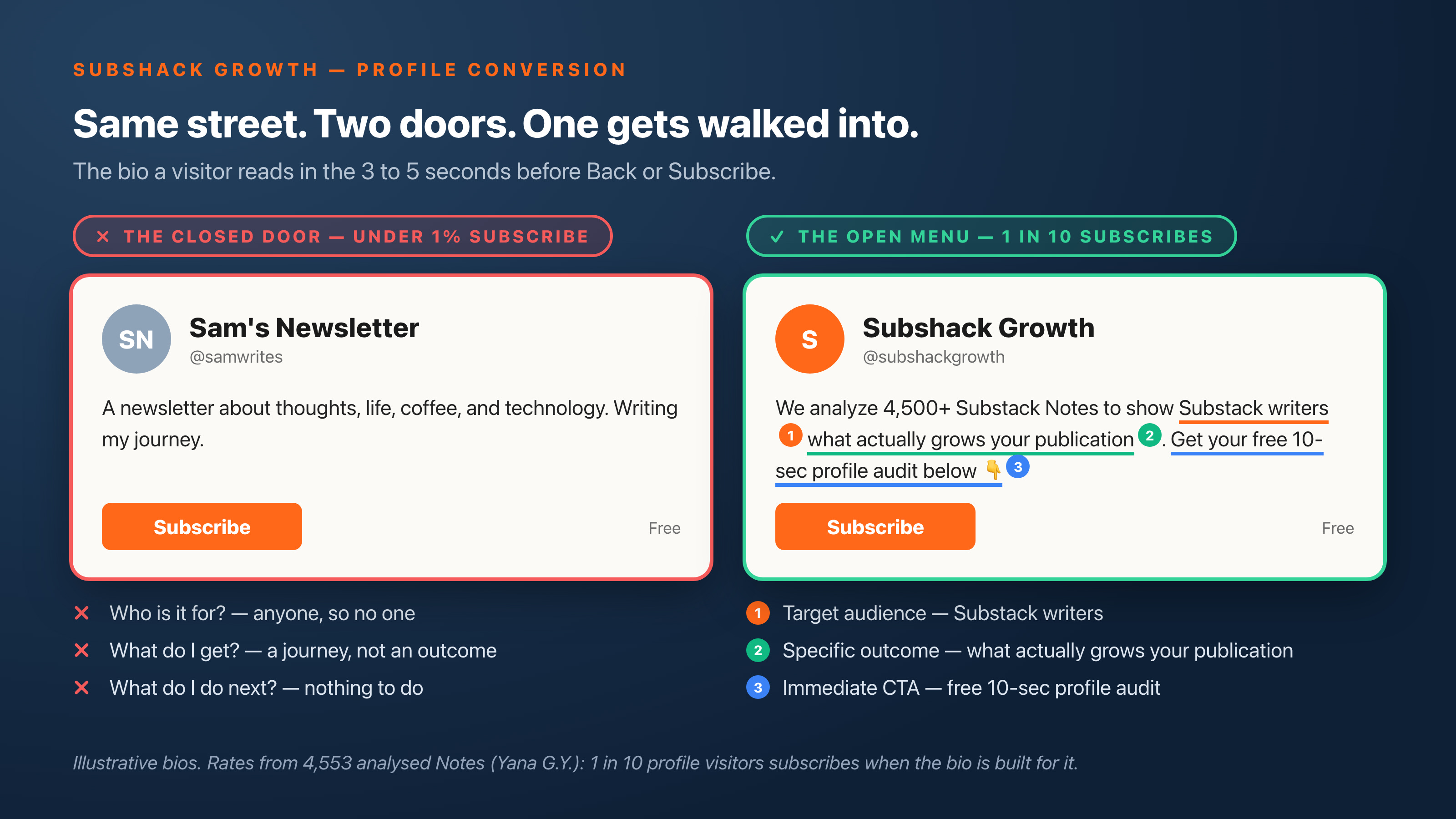
The cost of a “closed door” bio
According to Sarah Fay, PhD, the single biggest headline and profile mistake writers make is confusing poetic self-expression with functional clarity.
When a reader taps your name on Notes or clicks your link from social media, you have a 3-to-5 second window before they decide to hit “Back” or tap “Subscribe”.
Across hundreds of profile audits, three recurring “closed door” bio patterns destroy conversion rates:
The Personal Diary: “Notes on books, coffee, life, and my random thoughts.” A complete stranger has no incentive to give you their email address for your personal diary.
The Vague Visionary: “Rethinking the future of humanity and work.” Too broad it promises everything and delivers nothing specific.
The Silent Storefront: a bio that states a topic but includes zero call-to-action, and no indication of what happens next.
The 3-part high-converting bio formula
To convert cold profile taps into dedicated subscribers, your bio must act as a clear storefront menu. In Yana G.Y.’s Conversion Blueprint and Subshack’s 100-point profile framework, high-converting bios follow a strict 3-part structure:
1. The specific target & transformation (who & what)
State exactly who you write for and what specific problem you solve.
Weak: “Writing about newsletter growth.”
Strong: “Helping Substack writers convert profile visits into email subscribers with real data.”
2. The proof or cadence anchor (why trust you)
Give the reader a reason to trust your authority, or a predictable expectation.
Examples: “Based on 4,500+ analyzed Notes” · “10+ years in B2B SaaS” · “Every Saturday morning.”
3. The micro call-to-action (what to do next)
Never leave the visitor guessing. Direct them to your free tool, pinned post, or welcome offer.
Example: “Audit your bio in 10 seconds below 👇”
Passing Sarah Fay’s “Bus Test”
Sarah Fay challenges every Substack creator with the Bus Test:
Imagine sitting next to a tired stranger on a bus. If they ask what you write about, can you explain it in one sentence so clearly that they immediately understand its value even if they aren’t your target audience?
If your bio requires a reader to scroll through 5 past articles just to figure out what you do, you fail the Bus Test. Readers don’t subscribe to vague content; they subscribe to clarity and predictable transformation.
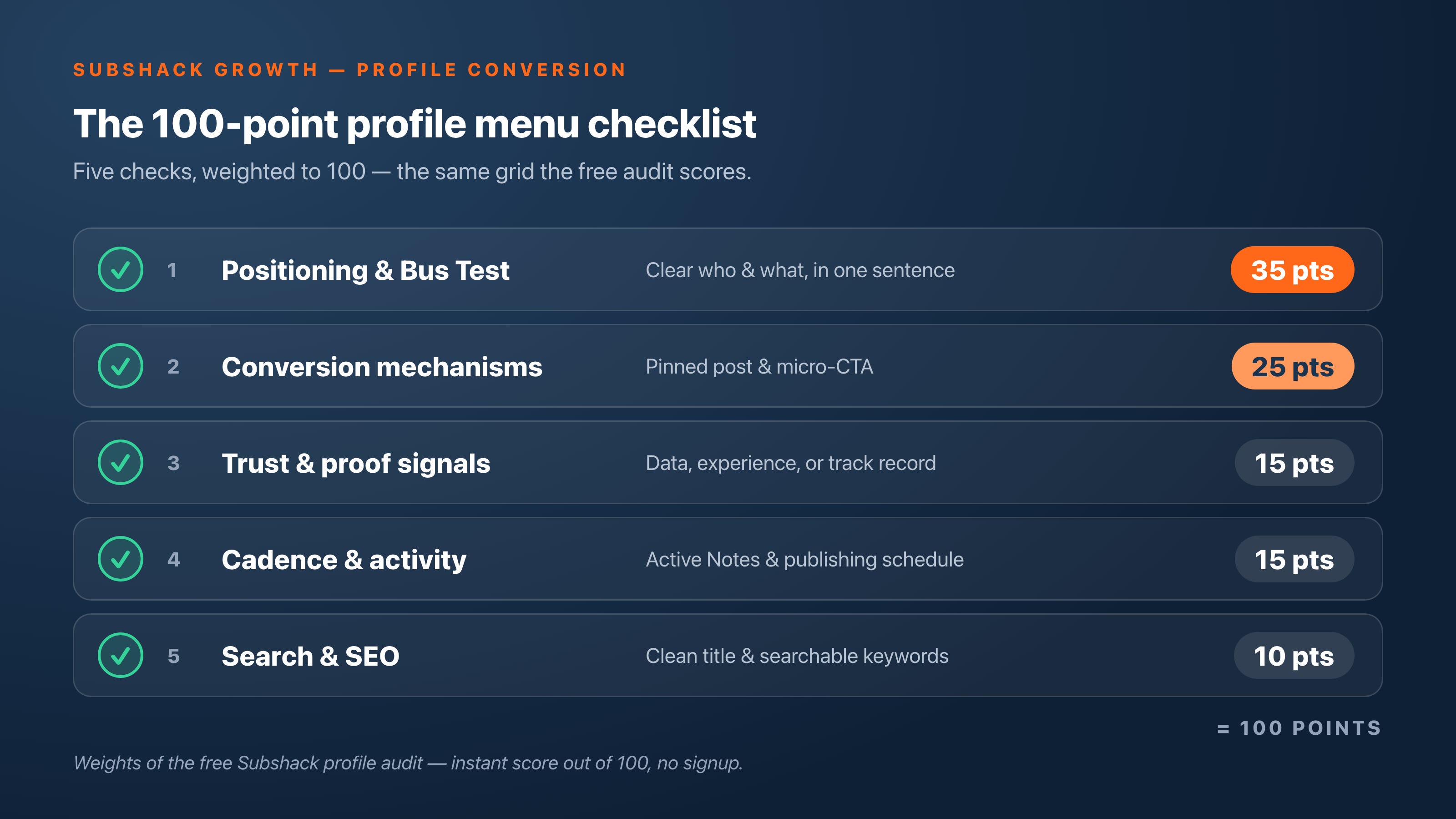
The 100-point profile menu checklist
Five checks, weighted to 100 the same grid the free audit scores. Positioning alone is worth more than a third of it.
Put a menu on your door in 10 seconds
Stop letting interested profile visitors walk away because your front door is locked. The free Substack profile audit runs the 100-point diagnostic on your profile in 10 seconds no signup and tells you which of the three parts your bio is missing.
What does your current bio look like? Drop it in the comments below, and let’s rewrite it together into a high-converting 3-part menu. 👇
Currently mine states: “Reimagining profitable business design without quietly consuming the person who built them. I speak biz architecture, capacity, and intelligent systems that let the ambitious build something Cent-sational + still have a life outside of it.”