


My subscriber count was rising.
My open rate was falling—from 34% to 18%.
A subscriber is not always a reader. Some people find your work and genuinely want more. Others arrive through a subscribe-for-subscribe thread, ask you to return the favor, and eventually drift away.
Both increase your subscriber count. But they do not build the same audience.
The question Substack makes difficult to answer
You’ve probably seen this message:
“Subscribed ! Your turn.”
You subscribe back. A few days later, you have no simple way to check whether that account is still subscribed to you. Once is easy. Forty times is not.
So I built the Substack Subscribe-Back Checker. It reads a public profile’s subscription list and sorts every publication into three groups:
Mutual — both sides are subscribed today.
One-way — you subscribe to them; no subscription back is publicly visible.
Publicly unverifiable — they keep their subscriptions private, so nobody can check either way.
I ran it on my own list first
I subscribe to 488 publications. The free scan reads the 40 most recent. The ones where a subscribe-back would still be recent enough to matter.
7 mutual. 19 one-way. 14 publicly unverifiable.
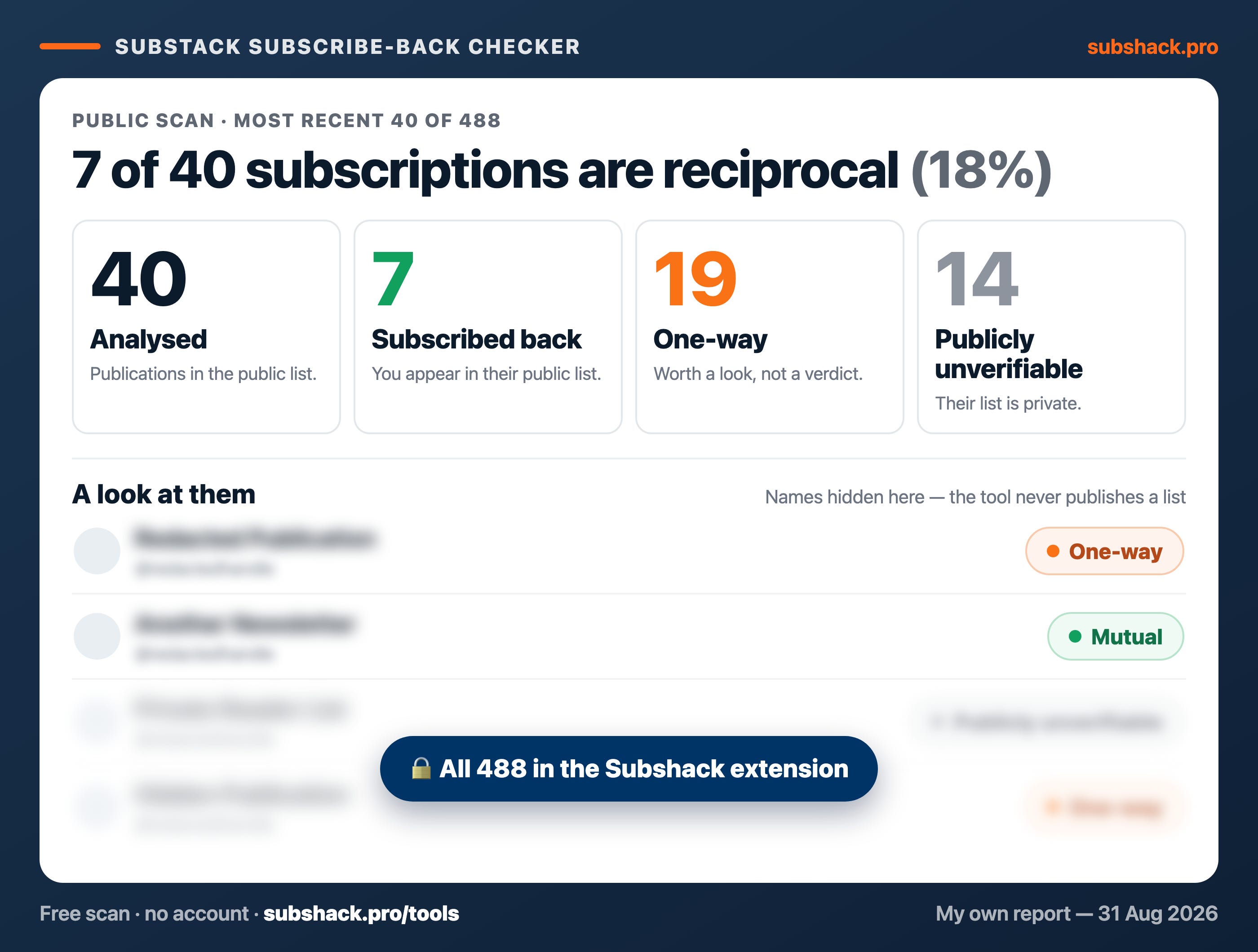
Seven. I had expected something closer to half.
That third number matters as much as the first. A private list stays private, and Subshack never opens it. Unverifiable means unverifiable not “they didn’t.”
A one-way subscription is not a betrayal
I subscribe to plenty of writers who will never subscribe to me. That is normal. I read them.
The better question is the other one: how many newsletters sit in your inbox only because you once felt obliged to return a subscription?
The checker never accuses anyone. It describes a relationship as it looks today. Someone may have used another account, or unsubscribed later. That is why a one-way result is a lead to review, never a verdict.
Check your own list
Before you scan, guess your number. Under 20%? Around 40%? More than 60%? Then run it and compare.
No account, nothing to install. The free scan covers your 40 most recent subscriptions and gives you every total. To cover all of them — mine were 488 — the Subshack Chrome extension runs the same check from your own browser, under Audit › Sub-for-sub.
A bigger number feels like progress. Knowing who is actually behind it is more useful.
Even though I haven’t been on Substack for long, I’ve been researching this trend, and recent platform updates seem to be amplifying the issue. Substack is increasingly adopting social media mechanics, causing its core, original purpose to drift into the background.
A clear sign of this is how “S4S” or “looking for authors in X/Y topics” notes systematically get far higher reach than substantive content. Meanwhile, the user experience has quietly shifted: for those joining via the mobile app, new subscriptions often default to “Prefer app”rather than active email notifications. (In the IOS app settings it’s called “Prefer push”, which is funny because there is no push notification if a publication I’ve subscribed to publishes a new post.) Given that media consumption is heavily moving to mobile - fueled further by podcast features - this effortless app onboarding is likely becoming the norm.
This creates a structural paradox. The line between a “Subscriber” and a “Follower” has blurred to the point of disappearing. An app-registered subscriber who doesn’t receive emails is functionally just a follower; they only see your work if they happen to scroll past it. If someone subscribes to 365 publications under this model, they’d need to read a post every day just to catch one piece per creator each year.
The platform lacks a simple way to manage this - a built-in “Favorite” feature, for instance, could easily let readers choose which publications merit direct inbox delivery versus feed-only updates. Without that, fine-tuning notifications requires navigating buried desktop settings that most mobile users will never touch.
The system relies heavily on network effects - and yes, the algorithmic distribution inside the default “For You” Notes feed and Recommendation engines - which inevitably favors larger accounts. Chasing subscriber count persists because on the one hand it remains the most visible vanity metric, and on the other hand it directly feeds those discovery mechanisms and algorithm.
It’s not necessarily a critique, but an observation: anyone looking for the “old, pure newsletter Substack” seems to chase a mirage. Tools like yours are becoming essential precisely because the platform’s default incentives now favor network volume over focused, inbox-level attention.